


Most LED flicker comes down to four culprits: an incompatible dimmer, a failing driver or power supply, loose wiring, or voltage drop on an LED strip. Before anything else, swap in a known-good, labeled dimmable LED bulb and make sure the original is seated properly. Notice whether the flicker sticks to one fixture or shows up across several rooms. That distinction alone tells you a lot about where to look next.
- Turn off power at the switch or breaker before touching a fixture or socket.
- Swap the bulb, confirm it is dimmable and correctly rated for the fixture.
- Watch whether the flicker is isolated or spreads across multiple fixtures.
- Stop immediately if you smell burning, see sparks, or the breaker keeps tripping.
Key Takeaways
Most LED flicker traces to a bulb, driver, or dimmer mismatch, and matching the flicker’s pattern and scope to the right cause is what turns guesswork into a fast, safe fix.
| Point | Details |
|---|---|
| Start with the bulb | Swap in a known-good dimmable LED first; it resolves the majority of flicker cases on its own. |
| Match scope to cause | One fixture flickering points downstream; multiple rooms flickering points upstream toward the panel. |
| Check the dimmer | Flicker only at low brightness usually means a minimum-load or compatibility issue, not a bad bulb. |
| Size LED strip power correctly | Undersized power supplies and long runs without added feeds cause voltage-drop flicker in strips. |
| Upgrade to quality parts | Montreal Lighting & Hardware supplies tested fixtures, drivers, and dimmers built to reduce repeat flicker. |
Table of Contents
- LED Flicker Troubleshooting: A Step-by-Step Checklist
- What Causes LED Lights to Flicker in the First Place?
- How Do You Fix LED Flicker Once You Know the Cause?
- When Should You Call a Licensed Electrician?
- Why Quality Fixtures and Drivers Stop the Flicker for Good
- DIY or Call a Pro? Our Honest Take
- Ready to Replace a Flickering Fixture?
- Frequently Asked Questions
- Sources
LED Flicker Troubleshooting: A Step-by-Step Checklist
Work through this in order. Each step either fixes the problem or tells you where to look next.
- Observe the pattern. Does the flicker happen on one fixture, one circuit, or across the whole house? Scope matters more than almost anything else here.
- Swap the bulb. Try a known-good, dimmable LED in the same socket. If the flicker follows the old bulb, the bulb or its internal driver is the likely cause.
- Move the fixture or bulb. Test the same bulb on a different circuit, or put a different bulb on the suspect circuit. This separates a bulb problem from a wiring or panel problem.
- Bypass the dimmer. Wire the fixture temporarily to a standard switch, or test it on a non-dimmed circuit, to rule out the control itself.
- Run an appliance test. Turn on a dryer, air conditioner, or other high-draw appliance and watch for flicker or dimming elsewhere in the house. That points to voltage sag.
Write down when it happens, whether dimming triggers it, whether it follows appliance startup, and whether you hear a buzz or feel heat at the switch plate. That log is exactly what an electrician will ask for if you end up calling one.
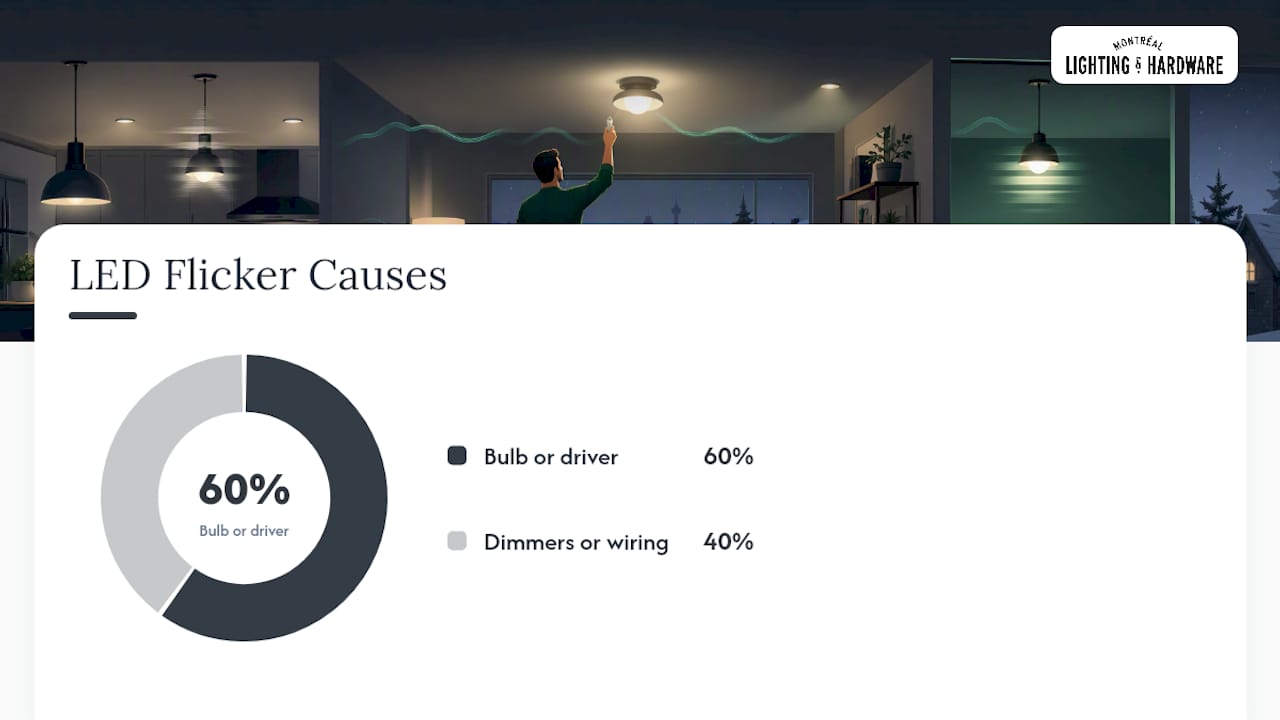
Pro Tip: Research on flicker cases suggests roughly 60% trace back to the bulb or driver, with the remaining 40% tied to dimmers, wiring, or installation. Start with the bulb swap. It is the fastest test and resolves the majority of cases outright.
Always cut power at the breaker before opening a fixture or handling wiring, and stop if you notice arcing, scorch marks, or a hot junction box.
What Causes LED Lights to Flicker in the First Place?
Different causes leave different fingerprints. Matching what you see to the list below saves you from guessing.
- Incompatible or old dimmer. If flicker only shows up when dimmed, especially near the low end, and comes with an audible buzz, the dimmer is not built for LED loads. Older leading-edge dimmers designed for incandescent bulbs are the usual suspect, and behavior often varies bulb to bulb on the same switch.
- Failing driver or low-quality power supply. Flicker at any brightness level, not just when dimmed, points to the driver. This shows up more often with cheaper bulbs or an entire batch from the same box, and it tends to worsen with heat or age. Undersized or poorly built drivers are a recurring cause of recurrent flicker.
- Loose wiring or a loose bulb. Flicker that changes when you touch the fixture, tap the wall, or walk past it usually means a loose connection somewhere. Watch for warmth, discoloration, or a faint burning smell at the socket or switch.
- Voltage sag from an overloaded circuit. If lights dim or flicker whenever the fridge compressor kicks in or the dryer starts, you are watching voltage sag under load, not a bulb problem at all.
- LED strip flicker. Strips flicker almost exclusively because of the power supply itself or voltage drop over a long run, especially past six or seven meters on a single feed.
Pro Tip: Scope is your best clue. A flicker confined to one fixture usually points downstream, to the bulb, driver, or local dimmer, while flicker across multiple rooms points upstream, toward the circuit or panel.
How Do You Fix LED Flicker Once You Know the Cause?
Start simple and work toward the more involved repairs. Most homes never need to go past step two or three.
- Replace the bulb. Choose a quality, clearly labeled dimmable LED and confirm the base type and wattage equivalent match the fixture. A mismatched bulb causes more flicker complaints than people expect.
- Fix the dimmer. If flicker only shows up when dimmed, check the dimmer’s compatibility list against your bulb brand. Swapping to an LED-rated trailing-edge dimmer usually solves it outright. If the dimmer flickers only near the bottom of its range, a minimum-load issue is likely, and a load-correction device or different dimmer model fixes it.
- Replace the driver or power supply. For integrated fixtures, this may mean the whole fixture. For external drivers, match constant-voltage to constant-voltage strips and constant-current to constant-current loads, and buy a driver with headroom above your actual wattage draw plus a wide input-voltage range.
- Fix LED strip runs. Calculate voltage drop over the run length, shorten long runs or add a second power feed partway down, and size the power supply above your actual load rather than right at the limit. Thicker feed wire helps on longer runs too.
- Check wiring. Reseat bulbs firmly and inspect visible connections at the switch plate for looseness or discoloration. Anything inside the panel, at a neutral connection, or behind a wall is an electrician’s job, not a weekend project.
When buying replacement parts in Canada, check the dimmable label, the driver type (constant voltage versus constant current), the input-voltage range, and, where listed, the percent flicker or PWM frequency rating. Always isolate power at the breaker before working on any termination.
When Should You Call a Licensed Electrician?
Some symptoms mean stop, not troubleshoot further. Call a licensed electrician right away if you notice a burning smell, visible sparks or arcing, a warm or hot switch plate, scorch marks around an outlet or fixture, or a breaker that keeps tripping.
- Flicker affecting multiple rooms or the whole house, rather than one fixture.
- Flicker that started right after a storm, power outage, or panel work.
- Any sign of arcing, since loose neutral connections carry real fire risk and are not something to leave alone.
Panel and service-neutral work in Canada needs a licensed electrician, full stop. That is not caution for caution’s sake. It is code compliance and basic fire safety.
Why Quality Fixtures and Drivers Stop the Flicker for Good
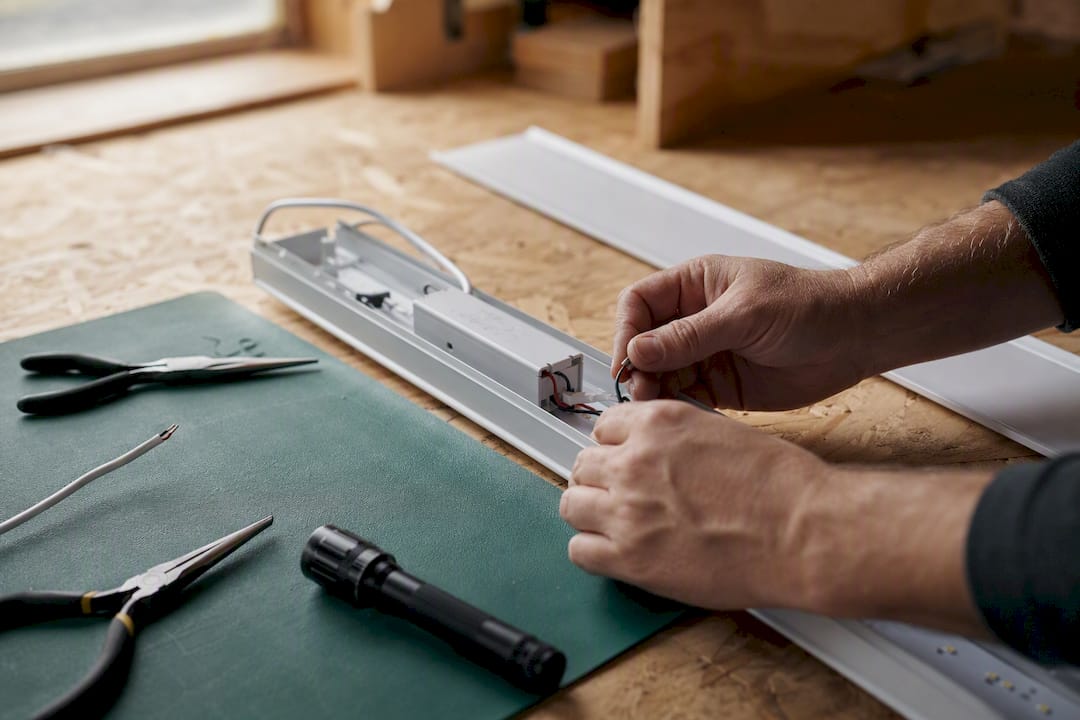
Cheap bulb-and-dimmer combinations often “fix” flicker for a few weeks before it creeps back. A well-built constant-current driver handles voltage ripple more cleanly than a bargain one, which cuts down on the PWM artifacts your eyes actually register as flicker. Pairing that driver with a genuinely tested dimming compatibility list, rather than a stab in the dark, is what separates a permanent fix from a temporary one.
Montreal Lighting & Hardware stocks fixtures, dimmers, and drivers built with this kind of compatibility in mind, with showroom support and shipping across Canada, so you are not left guessing at specs from a shelf label.
- If you are replacing more than one fixture on a circuit, standardize the bulb and driver models across all of them.
- Write down model numbers as you go. Future you, or your electrician, will thank you.
DIY or Call a Pro? Our Honest Take
Bulb swaps, dimmer upgrades, and strip power supply fixes are well within reach for most homeowners. Wiring inside walls or anything touching your panel is not. Log what you observe, then bring that log to Montreal Lighting & Hardware or your electrician.
Ready to Replace a Flickering Fixture?
Once you have traced the flicker to a tired driver or a bulb that never should have shipped dimmable in the first place, the fastest fix is starting fresh with a fixture built to handle it properly. Montreal Lighting & Hardware stocks tested LED fixtures and compatible components across Canada, with fast shipping and showroom support if you want a second opinion on specs before you buy.

For enclosed spaces like bathrooms, where heat buildup shortens driver life faster, a purpose-built option like the Jennings LED bathroom vanity is worth a look. If you are furnishing a larger space, browse Montreal Lighting & Hardware’s full collection to compare fixture specs, driver types, and dimmer compatibility before you order. Check the wattage, dimmable rating, and driver type against your existing switch before checkout, and you will avoid buying the same flicker problem twice.
Frequently Asked Questions
Why do my LED lights flicker only when dimmed? Your dimmer likely was not built for LED loads, or the LED load falls below the dimmer’s minimum threshold. Swapping to an LED-rated dimmer or adding a load-correction device usually fixes it.
Why is my LED flickering even at full brightness? Flicker that shows up regardless of brightness usually points to the bulb’s driver or an aging power supply rather than the dimmer or wiring.
How do I stop LED strip lights from flickering? Check for voltage drop over long runs, confirm your power supply is sized above your actual wattage load, and add a second power feed if the run exceeds roughly six meters.
Can loose wiring cause LED flicker? Yes. Flicker that changes when you touch the fixture or wall plate often signals a loose connection, and any heat, smell, or scorch marks mean it is time to call a licensed electrician.
When should I stop troubleshooting and call an electrician? Call one immediately if you see sparks or arcing, smell burning, feel heat at a switch plate, or notice flicker spreading across multiple rooms rather than staying at one fixture.
Sources
- How to Fix Flickering LED Lights in Your Home - Infinite Electric & Air
- LED Light Flickering: Causes and Easy Fixes | LEDVANCE
- Why LED Light Bulbs Flicker: Causes, Diagnostics, And Procurement Tips - RC Lighting
- PLC controlled LED dimmer flickering at low output fix - Industrial Monitor Direct
